


If you had passed the Provincial Grand Registrar John Gibson, of Scarisbrick Lodge No 2295 on the Pilgrims Way that August, you might not have noticed anything unusual at first. Just another lone figure under a bright wide Kent sky, dust on his legs, rucksack on his back. But then you’d look down to his feet and do a double take. Flip flops.

Not the high-tech boots and trekking poles you might expect on England’s ancient paths, but a simple pair of battered flip flops quietly slapping the sun-baked trail. Dover to Canterbury follows the bones of the old Pilgrims Way, trodden by countless feet on the road to the shrine of Thomas Becket. On that day, the tarmac shimmered, the chalk dust clung, and the sun hammered down on exposed downs and hedge less tracks.
Pressing on the next day, heading part-way towards Rochester. The distances weren’t unusual, but the heat, and the choice of footwear, certainly caught the eye. An idea was formulating in John’s mind for a much larger walk. Not the straight, sensible route that most people would choose. The hard way. The old way. Linking together some of Britain’s most ancient trackways, paths like the Ridgeway, which has borne human footsteps for 5,000 years. John realised that he could zig zag them all, following ancient ways up to Melrose, Scotland.
For years, most of his walking had been done in the unfriendly seasons, winter and spring, when the wind cuts across the hills and rain turns paths to mud. John explained he would do most of the walking in the bad weather seasons of winter and spring: “I actually preferred it, fewer people, quieter paths, and you feel like you’ve earned every mile.”
The obvious question persists, “Why flip flops?”, They’re brilliant, explained John without irony. The Romans did it in flip flops, and they’re the only things that never give me blisters, after trying all sorts of other footwear. John has tested boots, trail shoes, trainers, all the usual suspects. Something always rubbed, pinched, or overheated. So, the miles tick by: chalk track, forest path, Roman road, farm lane. 25 to 30 a day on the flat, 20 on undulating hills, 18 over mountains. The distances are matter-of-fact; the footwear, anything but. A quest like this, you would expect to encourage companions to lift the spirits along the way, John, commented that one friend and his daughter accompanied him once, but the distances involved put them off.
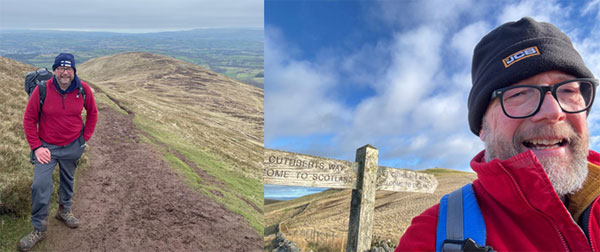
So, he walks alone, most of the time. Across Berwick-upon-Tweed and the Northumberland coastline. Out to Holy Island, timing his pilgrimage with the tide. Along Heavenfield and the stark line of Hadrian’s Wall. Through Carlisle and Chester, Monmouth and Chepstow, Winchester, Salisbury and Guildford, to name a few waypoints. Every long walk has its moments of grace and its moments of fear. “Pandy to Hay-on-Wye,” John said: “That stretch was the high point. Literally and metaphorically. It’s a ridge walk with fantastic views, wild horses, and then you finish in the capital of second-hand books in Hay. You come off the hills and suddenly you’re surrounded by bookshops. Bliss.”
The low point came far from bookshops, on the Cumbria Coastal Way near Maryport. “I nearly slipped in the mud on a cliff there,” John remembers. “100s of feet down. One moment’s loss of footing and that would have been it. It focuses the mind very quickly. You realise that, for all your planning, you’re never entirely in charge out there.”
It is perhaps in those moments, a ridge alive with skylarks, or a slick clay path above a hungry drop, that the ‘pilgrimage’ part of the journey reveals itself. For all its solitary miles, the walk hasn’t been entirely a private affair. Towards the end of one long phase a little friendly lodge encouragement came into play. John had a wager towards the end of the walk, with the brethren of Scarisbrick Lodge, when they urged him on to finish it, and when completed, paid £1,000 into the West Lancashire Freemasons’ Charity. John is a member of Scarisbrick Lodge, the University of Liverpool Chapter No 4274 and the Provincial Grand Stewards’ Chapter of West Lancashire No 8516.
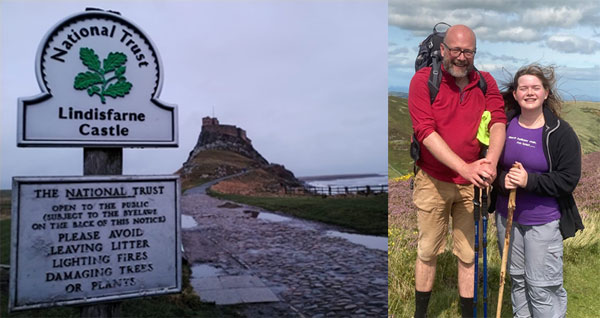
John’s walk has taken in some iconic routes, The Pilgrims Way, threading through Kent and Surrey on its way to Canterbury. The North Downs Way, shadowing chalk ridges with views towards the English Channel. Offa’s Dyke Path, tracing the earthwork frontier between England and Wales. Hadrian’s Wall Path, striding along the remains of Rome’s northern boundary. The Cumbria Coastal Way and the Northumberland coast, raw with wind and weather. And the Ridgeway, five millennia of travellers, traders and pilgrims beneath his feet.
The journey, however, doesn’t end there, John would like to complete another path from Melrose to John O’Groats. Somewhere North of Melrose, there is a stretch of path waiting for the familiar slap of rubber against dust and stone. And when the weather turns, and the time is right, he’ll be there again, rucksack on back, in his trusty flip flops, and the old tracks unfurling ahead.
Story by Mike Fox.