


This ceremony is commonly performed around Remembrance Day to pay homage to all who served in past wars. The ‘Empty Chair Ceremony’ is a Masonic ritual originating in the American Civil War era, used to honour fallen and deceased brethren.

A chair is placed in a prominent position during lodge meetings, symbolizing their spiritual presence and the remembrance of their noble ideals. While its roots are in military conflict, the ceremony is now widely used by various lodges to commemorate Freemasons who have died in any war or conflict. The ceremony is not recognised by UGLE.
Many lodges also use it for other memorial services to honour any brother who has passed. Brethren of Corinthian & Borsdane Lodge No 2350 and their honoured guests assembled under the leadership of the WM Darryl Grundy to perform The Empty Chair Degree 1875, sometimes called the Vacant Chair Degree.
The ceremony is performed by a number of lodges around Remembrance Day to pay homage to those brother Masons who fell during both World Wars and other conflicts. This ceremony was adapted for Corinthian & Borsdane Lodge by the lodge DC Neil Whittle, the lodge secretary Peter Newell provided great assistance throughout.
After the lodge formalities ended and the lodge was closed. The WM asked visitors to enter the lodge, and said: “Our next business is to present a token of remembrance entitled The Empty Chair, the original version was first presented in the Grand Lodge of New Brunswick, Canada, May 1948.”
At this point William Wilding and Mark Foster approached the centre, Darryl said: “This evening, we will be honouring Masons who fell during times of war, as they have gone to the Grand Lodge above, and can no longer attend our lodges, it will be your duty to escort their symbolic representation to us, that we may pay them the respect they are due, the ceremony continues.”
The tyler reported that brethren who have fallen in service of their country seek admission here, not in person, but through their spiritual presence. They seek our continued remembrance; through them they wish to honour the memory of our departed brethren who answered the summons to the Grand Lodge above. William and Mark entered, bearing the Roll of Honour and wreath halting in front of the senior warden.
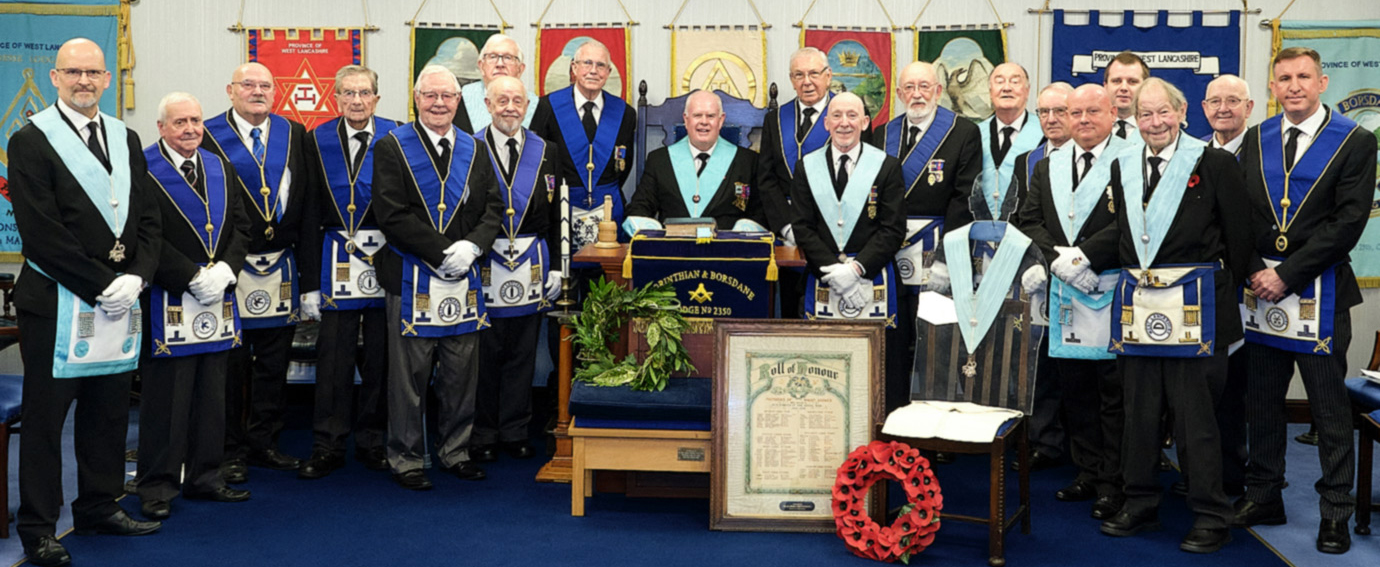
Darryl asked William and Mark to advance to the east and place the symbolic representation of our fallen brethren next to the podium. They advanced to the east and place the Roll of Honour and wreath next to the podium, facing West. Darryl stated that it is order that, in recognition of our fallen brethren, and their status as Masons, that the apron of an entered apprentice be positioned as it would be if our brethren were present in body as well as in spirit.
Lambskin or white apron was the first gift of Masonry to our departed brother. It is an emblem of innocence and the badge of a Mason. This emblem was placed on the seat of our deceased brother, a symbol of recognition of his dedication to the highest ideals of the Craft during times of war. The collar on the chair/silhouette was placed because, by this act, we are reminded of the Masonic ideals of our fallen brother and his fellows. We see in clear vision the noble thoughts, generous impulses, words of truth, acts of love and deeds of mercy. The Masonic apron represents the highest aspirations of a brother in all ways, as each brother knows they give to man his only genuine happiness, his lasting satisfaction. To these precepts, our brothers willingly and gladly subscribed.
Our brother and his fellows gave themselves freely, not only to the degrees of Freemasonry, but also to the obligations of service to their country in times of need. They garnered the honours of their peers, their superiors and those who looked to them for leadership at home, as well as on foreign shores. Alan Johnson and Peter Newell approached the chair and placed medals on the apron.
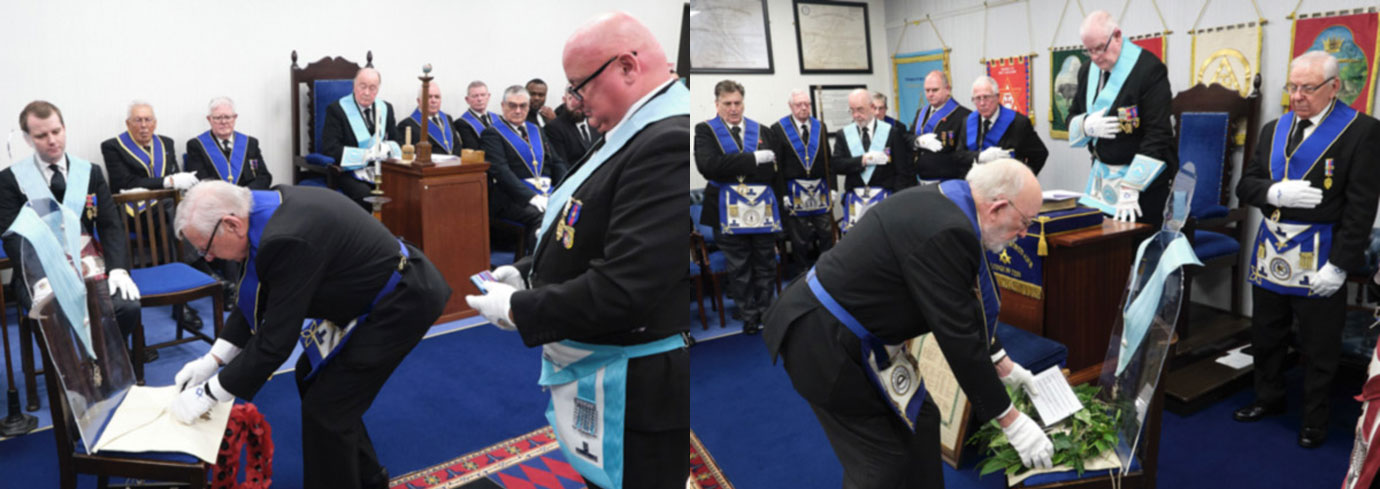
It is said a man is made a Mason first in his heart. The Mason may have earned honours before, or after he is raised to the third degree. But as the world sees those honours do not decorate his Masonry, but rather highlight the spirit, which made both a Mason and a man of service. The chaplain approached the chair.
The evergreen is an emblem of mortality, beyond this world of shadows, man has a glorious destiny, since, within this earthly tabernacle of clay there abides an imperishable and immortal spirit, over which the grave has no power, nor death dominion. The chaplain, advanced to the east and placed the evergreen on our brother’s apron, a symbol of the immortality of his soul and recite for the brethren the 23rd psalm. The brethren were upstanding and the chaplain recited 23rd Psalm.
Brethren to whom we pay tribute this evening were Masons. They gave their lives in the belief that, because of them, and men like them, we would be able to enjoy the freedom to enjoy this evening in the lodge. The junior deacon Ray Pye then said: “At this time of year, it is a tradition to wear a poppy as a symbol of remembrance, a tradition that began in the spring of 1915 when, shortly after losing a friend in Ypres, a Canadian doctor, Lieutenant Colonel John McCrae wrote the poem, ‘In Flanders’s Fields’.” The WM thanked the brethren and visitors and informed everyone that the Ceremony of Remembrance was concluded.

The social board on this occasion consisted of a great number of brethren and guests many were non-Masons who were overwhelmed by the spectacle they had witnessed in the lodge room. At the social board, the secretary informed all present that remembrance wasn’t just about those who had fallen during conflict, but was about remembrance of all. The WM informed everyone present that since the new millennium, Corinthian & Borsdane Lodge have had 48 brethren called to the Grand Lodge above. The deceased brethren’s names were read out by five of the brethren.
Many non-masons were present to witness the ceremony, having been inspired by what they had seen so far where certainly were very keen to ask about Freemasonry and its membership options. There were much fun and laughter with raffles and prizes, and particularly important was the making of new friends and catching up with old acquaintances. This was a truly wonderful evening that was enjoyed by all with an exceptional food choice menu.