


The Liverpool Group of Freemasons, partners and friends, held their annual Remembrance Service for those that had fallen in conflicts past and present. For those that have not visited Hope Street Masonic Hall, on entering, the War Memorial is situated at the end of the corridor before entering the main building.
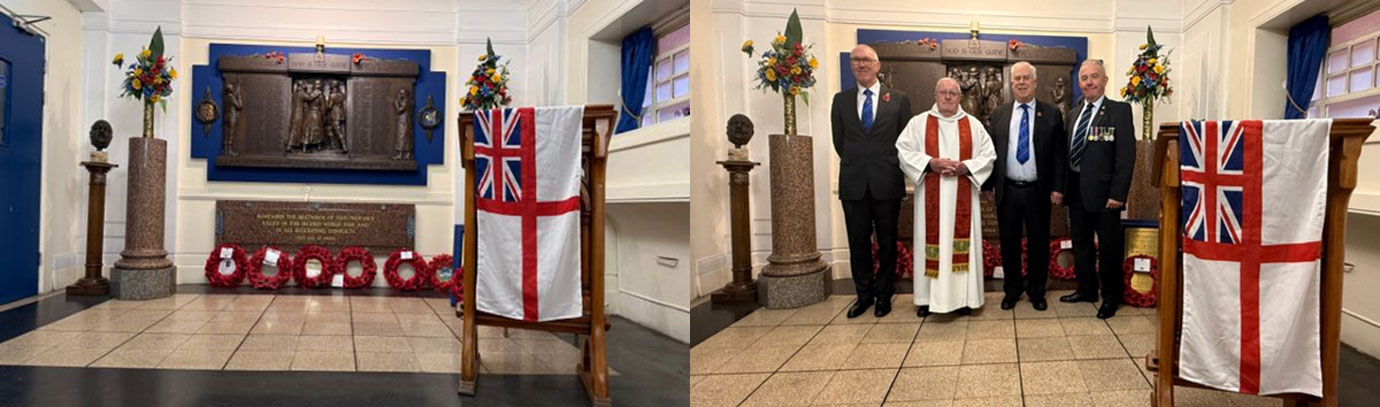
The main plague records 118 names of Masons that were killed during the 1914 -1918 war. It is adorned either side by large marble pillars, which support engraved battery shells containing flowers. Either side of the engravings is a coat of arms, and on the other the Liverpool Liver Bird. Underneath the names on a marble stone are engraved the words; ‘Remember the brethren of this Province killed in the Second World War and in all succeeding conflicts they are at peace.’
The memorial has recently been updated with a tribute to Walter Bigland, Royal Marines Commando, and was a member of Everton Lodge 823, who sadly passed away in February 2024, aged 99 years, a veteran of the D Day Landings. The memorial is a truly honourable remembrance for those who gave their lives, and those entering and leaving the building can view and remember, including those who knew Walter.
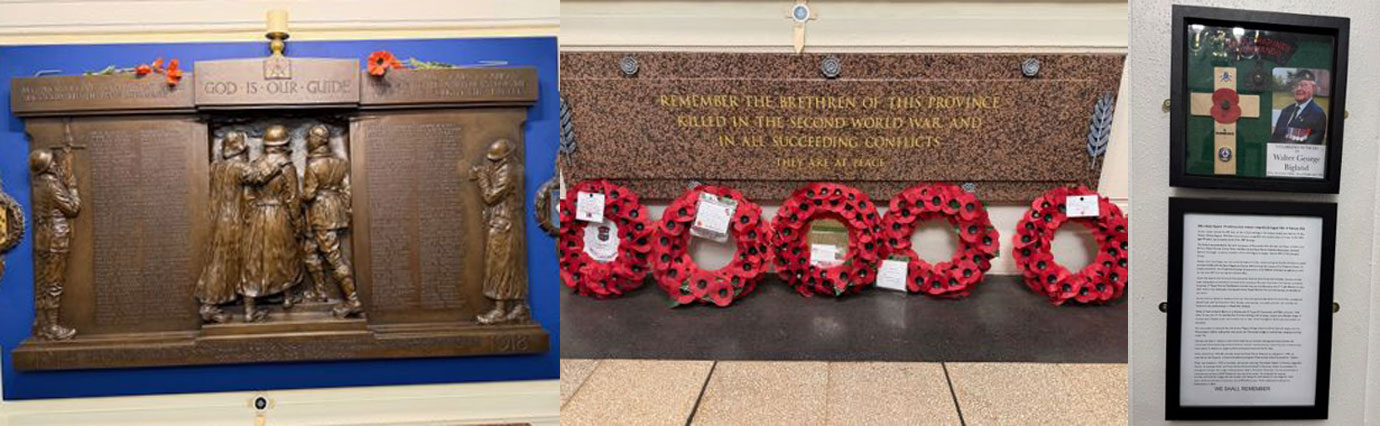
Those attending were greeted by the Liverpool Group Chairman Dave Johnson who thanked everyone for coming, for what was a very important time to remember not only those that gave their lives as service men and women, but also those who lost their lives during their duties for the emergency services and associated civil operative departments at that time, including the Merchant Navy.
Dave introduced the Reverand John Williams (retired), who commenced the Remembrance Service, with a call to remembrance scripture and scripture sentences. There then followed the exhortation, Last Post and two-minute silence before the sounding of reveille. Words of affirmation were given followed by wreath laying and a prayer of commemoration. A blessing was given, and the National Anthem then sang.
After the service, Dave took the opportunity to explain the new addition to the area which relates to Walter Bigland, and how on a visit to the beaches, and in the associated museum, Walter saw the picture of himself having exited the landing craft carrying his bike up out of the water, as he moved towards the hostile beaches.
Following the service, the brethren and visitors then stayed around for a while to reflect on the service and enjoy each other’s company with tea and sandwiches.