


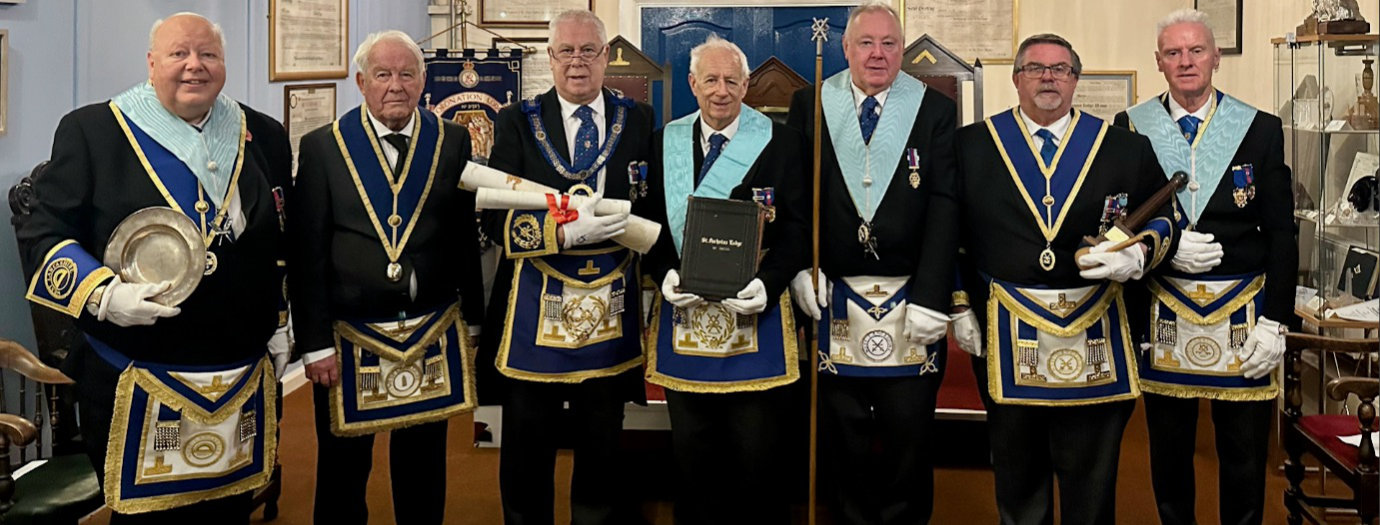
The brethren of St Nicholas Lodge No 3620 met at the League of Welldoers on Limekiln Lane, Liverpool for the final time, to close and surrender the warrant of the lodge after 114 years. WM Stewart Cranage called the brethren to order and, assisted by his senior warden, John Jackson and junior warden, Gus Anderson, the lodge was opened in solemn form.
Having opened the lodge in the third degree, Provincial Deputy Grand Director of Ceremonies, Robb Fitzsimmons entered the lodge and announced that Assistant Provincial Grand Master David Johnson, “stands without and demands admission”. The brethren stood to receive him and David, accompanied by Gladstone Group Vice Chairman Mike Fox entered the lodge. WM Stewart formally welcomed David to the lodge and once all were seated, the necessary salutations were attended to.
WM Stewart then rose and offered the gavel of the lodge to David Johnson, who on this sad occasion accepted the gavel and occupied the chair of King Solomon. David reminded those present, that the closure of a lodge is always a sad occasion, but it was also a celebration of a lodge with a long and distinguished history.
The lodge was born of the Sailors’ Church. A place of worship that has stood on the site of St Nicholas Church, near Liverpool’s Pier Head, since an early chapel of that name was consecrated in 1362. The church gave sanctuary to seafarers from all over the world who worked on the many ships using Liverpool’s docks. The founders of the lodge were closely linked to it, and the lodge warrant was granted in August 1912.
David explained that founding members came from lodges across the city and surrounding area, most were city-centre businessmen:
The first WM was George Bates who managed the Society for the Promotion of Christian Knowledge bookstore at 40 North John Street. The first senior warden was FCJ Dyke, a manager at Duncan Ewing, timber merchants, in Exchange Buildings.
The first junior warden was Dr John Owen, a prominent physician who practiced at 18 Rodney Street and served as honorary secretary for the local branch of the British Medical Association. The Reverend Ernest Urmston Savage, was the first chaplain, also chaplain of the Mersey Mission to Seamen. J Buckingham-Jones, was the first secretary who managed the Royal Exchange Insurance Company.
All those brethren brought a wide mix of skills and experience, but all worked within a stone’s throw of Exchange Station. Some may well have travelled through it on their way to and from work. The lodge was consecrated on Monday 25 November 1912 at the Exchange Station Hotel, which stood at what was then a busy terminus for trains between Liverpool and Scotland. More than 50 visitors attended alongside the members. The lodge would go on to outlive the hotel, which closed in the 1970s.
The patron that the founders chose was well suited to a port city. St Nicholas was an early Christian bishop, believed to have lived between about 270 AD and 340 AD. He is the patron saint of sailors and merchants, among many others and his generosity and secret gift giving gave rise to the legend of Father Christmas. Less than two years after the lodge was founded, the First World War began. The records show that St Nicholas Lodge continued meeting without interruption throughout the war and was very active in charitable work.
In October 1914 the lodge sent five guineas to the Red Cross, a large sum at the time and roughly £750 today. It continued to support the Red Cross throughout the war. In 1917 it gave £10 10s to buy an invalid chair for the Star and Garter Home of the British Red Cross Society. The lodge also met through the whole of the Second World War, and its charitable work continued. Keeping going through some of the darkest periods in the country’s history which shows the strength and determination of its members.
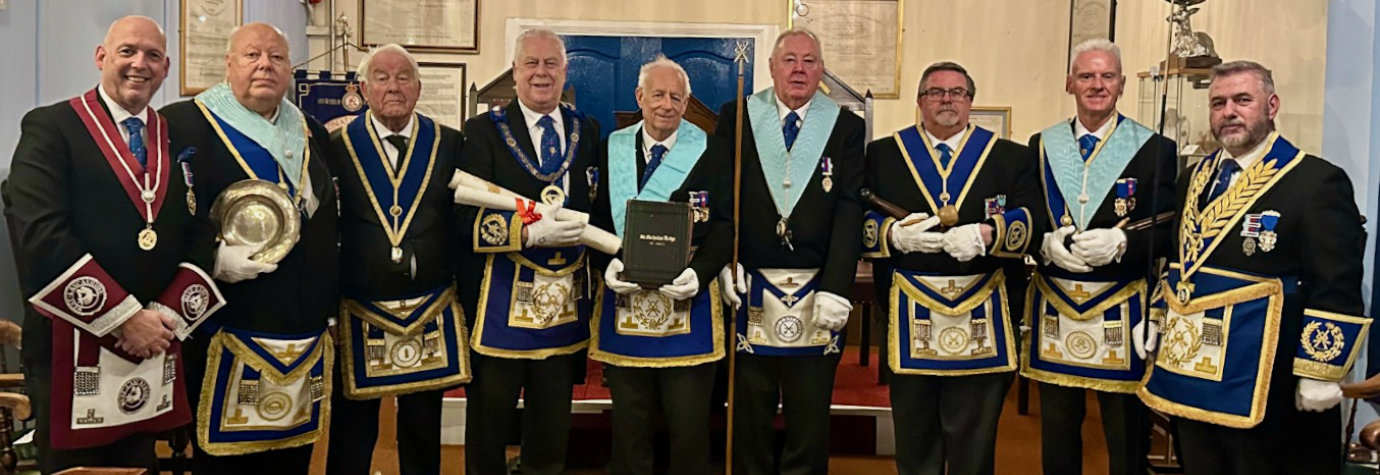
Over the history of the lodge, it produced five grand officers: Parkhouse in 1919, Hughes in 1923, King in 1926 and again in 1929 and recently lodge WM Stewart Cranage. Stewart has played a key role in building the Province’s mentoring scheme and more recently served as an Assistant Provincial Grand Principal. In addition, Bill Gilpin was also recognised for being the lodge’s longest serving member of more than 60 years’ membership of his mother lodge.
In November 2012 the lodge celebrated its centenary, however, in recent years, as in many lodges, membership has fallen, partly because of age and ill health. The brethren therefore made the difficult decision to close. For more than a century, St Nicholas Lodge has been many men’s introduction to Freemasonry.
David thanked the brethren and their predecessors for their service to their country, to their local communities and to Freemasonry in the Province of West Lancashire. He also gave his personal thanks for their commitment, hard work and loyalty to Liverpool Freemasonry.
The evening ended with the traditional valedictory address, which charged the brethren to “be ye all of one heart and mind, love one another and live in peace.” The lodge has closed, but St Nicks will not be forgotten.